

August 7, 2026
Every spring, thousands of high school players discover the same uncomfortable truth: talent alone doesn't get you recruited. Visibility does. College baseball recruiting rewards the players who understand the process — who show up with the right numbers, at the right events, in front of the right coaches, at the right time.
The good news is that the process is learnable. Here's how it actually works.
Understand the Levels Before You Chase Them
Roughly 2% of high school baseball players go on to compete at the NCAA Division I level. That number scares families, but it's misleading, because D1 is only one door. Between NCAA Divisions I, II, and III, the NAIA, and junior college programs, there are well over 1,700 college baseball teams in the United States.
Each level recruits differently:
- NCAA D1 — Early timelines, premium on velocity and exit velocity, limited scholarship equivalencies split across a large roster.
- NCAA D2 — Strong balance of athletics and academics, often more scholarship flexibility per player than families expect.
- NCAA D3 — No athletic scholarships, but significant academic and need-based aid. Frequently the best financial outcome for strong students.
- NAIA — Independent scholarship rules, aggressive recruiters, excellent competition.
- JUCO — The development path. Two years to add velocity, at-bats, and grades, then transfer up.
Before you build a target list, get honest about where your current numbers place you. A player who targets fifteen realistic programs will outperform one who emails forty dream schools.
The College Baseball Recruiting Timeline
NCAA rules changed meaningfully in recent years to push contact later, which helps families who start organized rather than early.
Freshman year (9th grade)
Focus on grades and development. Build a transcript that keeps every division in play. Start tracking your own metrics so you can show growth later.
Sophomore year (10th grade)
Begin attending a small number of quality showcases. Create your recruiting video. Build an initial target list of 20–30 schools across multiple divisions.
Junior year (11th grade)
This is the year. For most D1 and D2 programs, contact opens and evaluations get serious. Attend camps at your target schools specifically. Send updated video and verified numbers every time they improve.
Senior year (12th grade)
Signing periods, official visits, and — for many players — late-cycle opportunities as rosters shift. Don't panic if you're unsigned in the fall. Roster spots open in the spring every single year.
The Metrics Coaches Actually Filter By
College coaches evaluate hundreds of players a week. They filter by numbers first, then watch video, then watch you in person. If your metrics aren't verified by a recognized third party, many programs will not open the email.
The core numbers by position group:
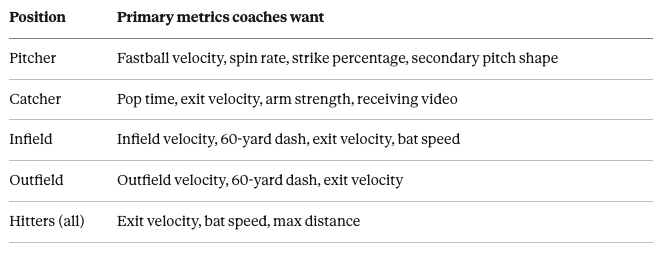
Get these verified at an event that produces a public profile. A self-reported 92 mph means nothing. A verified 89 means everything.
Build a Recruiting Video Coaches Will Finish
Assume a coach gives your video 30 seconds. Structure accordingly.
- Open with a title card: name, grad year, position, high school, height/weight, GPA, verified metrics, contact info.
- Lead with your best tool. If you throw, that's bullpen work from the side and behind. If you hit, that's live BP with a visible ball flight.
- Show defense from an angle that captures footwork, not just the catch.
- Keep it under four minutes. Unlisted YouTube link. No music, no slow motion, no highlight-reel editing.
- Never cut between the swing and the result. Coaches want to see the ball leave the bat.
How to Email a College Coach Without Getting Deleted
The average college coach receives well over a hundred recruiting emails per week. Most are generic. Yours shouldn't be.
A structure that works:
- Subject line: Grad year, position, one verified metric, name. Example: "2028 RHP — 88 mph FB — Marcus Reyes."
- First sentence: Why this program specifically. Name the coach. Reference something real — a recent series, their pitching development track record, a major you want to study.
- Second paragraph: Your verified metrics, GPA and test scores, and your video link.
- Third paragraph: Your upcoming schedule, so they know where they can see you play.
- Close: One clear question that invites a reply.
Then follow up. Coaches expect it. A short, polite update every four to six weeks with new numbers keeps you on the board.
Academics Are Leverage, Not a Backup Plan
At D3 and many D2 programs, your transcript is the scholarship. A 3.8 GPA can be worth more per year than an athletic package at a school that only has 11.7 scholarships to divide across 27 players. Coaches at academically selective schools also recruit high-GPA players preferentially, because those players are easier to get admitted.
Register with the NCAA Eligibility Center by your junior year. Take the SAT or ACT even where it's optional — a score opens academic aid at many institutions.
Common Mistakes That Cost Players Offers
- Emailing only D1 programs and starting the D2/D3 search in April of senior year.
- Attending large showcases with no target-school coaches in attendance.
- Sending unverified metrics.
- Letting a parent write and send the emails. Coaches notice immediately, and it counts against you.
- Going silent after one non-response.
Frequently Asked Questions
When should I start the college baseball recruiting process?Begin tracking metrics and grades in ninth grade. Begin serious outreach and showcases in tenth, with the heaviest contact period during junior year.
Do I need a recruiting service?
No. Services can save time, but nothing they do is out of reach for an organized family. Verified metrics, honest video, and consistent direct outreach do the majority of the work.
How many schools should I contact?
Twenty-five to forty, spread deliberately across divisions, with at least half at levels where your current numbers are already competitive.
Can I still get recruited if I play at a small high school?
Yes. Summer travel ball and verified showcase data neutralize school size almost entirely. Coaches recruit tools, not enrollment numbers.
Recruiting is not a lottery. It's a communication project with a deadline. The players who treat it that way — verified numbers, honest self-assessment, consistent outreach, real academics — end up with options. Start this week, not next season.
Check out our YouTube
My latest YouTube video or podcast episode has an in-depth discussion on this topic.
open youtubeListen to PodcastSubscribe to this newsletter
Every week, you'll get actionable tips to start, grow, and succeed in your recruitment process in less than 4 minutes.
Thank you! Your submission has been received!
Oops! Something went wrong while submitting the form.

About Alex
Meet your college baseball recruiting specialist: Alex Swenson.
As a high school baseball player, I navigated the college recruiting process all on my own. Despite average statistics, I landed a spot on a Division-1 baseball team Jacksonville University, where I became a 3-time team captain. Post-college, I became a D1 coach, scout, and recruiter at Georgetown University and Ole Miss, where we won an SEC championship.
After experiencing the process as both recruit and recruiter, I’ve successfully dissected the best strategies to connect with college coaches and draw offers from them.
After experiencing the process as both recruit and recruiter, I’ve successfully dissected the best strategies to connect with college coaches and draw offers from them.
Learn more about Alex’s Experience
Premier Athletes Recruiting Program
Receive professional direction from Alex himself until your son commits to his desired school. A step-by-step action plan will be provided with strategic small-group coaching meetings every 2 weeks to ensure we are making progress. Included is a baseball networking platform that connects him to coaches, optimizes his exposure to scouts, alerts him to college camps and showcases, and MUCH MORE.
Discover